Tuesday, May 8, 2012

The Campaign for Wool's Savile Row Field Day

While I was doing research in London in 2010 I was kindly invited by the people at Fox Brothers Flannel and the Savile Row Bespoke Association to attend the Savile Row field day to promote British Wool. The Row was filled with sheep, and I was invited to a VIP lunch with, among others, legendary tailor Edward Sexton. The event coincided nicely with the publication of James Sherwood's excellent book "Bespoke: The Men's Style of Savile Row." Here are a few pictures from the day:


Monday, April 23, 2012

The Count D'Orsay's Sled

In the memoirs of the Countess Blessington she describes a charming scene during a Parisian winter in which she and some friends go sledding in some astonishing vehicles. Among the revelers is the Count D'Orsay - Europe's most obvious heir to Brummell's dandy legacy. D'Orsay may have been the Countess's much younger lover - Lady Blessington and her possibly homosexual husband picked up the handsome young french nobleman and took him on a European trip with them. This was a great boon for the D'Orsay family, who were not as wealthy as their ancestors had been before the revolution, and welcomed their son's adoption into the Blessington menage, even if he may have seemed to some like a glorified gigolo.

The excerpt below is from Lady Blessington's memoir "The Idler in France," which can be read in full at Gutenberg.org.


The prettiest sight imaginable was a party of our friends in sledges, who yesterday passed through the streets. This was the first time I had ever seen this mode of conveyance, and nothing can be more picturesque. The sledge of the Duc de Guiche, in which reclined the Duchesse, the Duc seated behind her and holding, at each side of her, the reins of the horse, presented the form of a swan, the feathers beautifully sculptured. The back of this colossal swan being hollowed out, admitted a seat, which, with the whole of the interior, was covered with fine fur. The harness and trappings of the superb horse that drew it were richly decorated, and innumerable silver bells were attached to it, the sound of which was pleasant to the ear.
The Duchesse, wrapped in a pelisse of the finest Russian sable, never looked handsomer than in her sledge, her fair cheeks tinged with a bright pink by the cold air, and her luxuriant silken curls falling on the dark fur that encircled her throat.
Count A. d'Orsay's sledge presented the form of a dragon, and the accoutrements and horse were beautiful; the harness was of red morocco, embroidered with gold. The Prince Poniatowski and Comte Valeski followed in sledges of the ordinary Russian shape, and the whole cavalcade had a most picturesque effect. The Parisians appeared to be highly delighted with the sight, and, above all, with the beautiful Duchesse borne along through the snow in her swan.
My medical adviser pressed me so much to accede to the wishes of my friends and try the salutary effect of a drive in a sledge, that I yesterday accompanied them to St.-Cloud, where we dined, and returned at night by torch-light. Picturesque as is the appearance of the sledges by day-light, it is infinitely more so by night, particularly of those that have the form of animals or birds.
The swan of the Duchesse de Guiche had bright lamps in its eyes, which sent forth a clear light that was reflected in prismatic colours on the drifted snow, and ice-gemmed branches of the trees, as we drove through the Bois de Boulogne. Grooms, bearing lighted torches, preceded each sledge; and the sound of the bells in the Bois, silent and deserted at that hour, made one fancy one's self transported to some far northern region.
The dragon of Comte A. d'Orsay looked strangely fantastic at night. In the mouth, as well as the eyes, was a brilliant red light; and to a tiger-skin covering, that nearly concealed the cream-coloured horse, revealing only the white mane and tail, was attached a double line of silver gilt bells, the jingle of which was very musical and cheerful.
The shadows of the tall trees falling on an immense plain of snow, the light flashing in fitful gleams from the torches and lamps as we were hurried rapidly along, looked strange and unearthly, and reminded me of some of the scenes described in those northern fictions perused in the happy days of childhood.
This excursion and exposure to the wintry air procured me a good night's sleep,—the first enjoyed since the severity of the weather has deprived me of my usual exercise. This revival of an old fashion (for in former days sledges were considered as indispensable in the winter remise of a grand seigneur in France as cabriolets or britchkas are in the summer) has greatly pleased the Parisian world, and crowds flock to see them as they pass along. The velocity of the movement, the gaiety of the sound of the bells, and the cold bracing air, have a very exhilarating effect on the spirits.

Wednesday, April 4, 2012

The Chap: Benjamin Disraeli


The following is an excerpt from an article I wrote on Benjamin Disraeli for The Chap Magazine:


...Byron famously said that the most important men of his generation were Beau Brummell, himself, and Napoleon. If ever there was a man who embodied this trinity, it was Benjamin Disraeli, who achieved success first as dandy, then author, then politician.
Disraeli’s friendship with the famous dandy Count d'Orsay was his first step on the social ladder: “D'Orsay attacked me yesterday in Bond St. attired with a splendor I cannot describe, so dishevelled were his curls, so brilliant his bijouteries and the shifting tints of his party-colored costume. He knows who I am.” He boasted: “I've become this year very popular with the dandies. D'Orsay took a fancy to me, and they take their tone from him... I'm as popular with first-rate men as I'm hated by the second.”
He was soon quaffing claret and exchanging bon mots with the fashionable few, having affairs with married women, and dazzling London with his showy costumes and exotic Jewish looks. He wore velvet trousers and jackets, shirts with ruffles, flashy colored waistcoats, and glittering jewelry, including gold chains strung across his chest. He was famous for his perfect jet-black curls, particularly his dramatic forelock, one of the few pieces of his hair to stay with him to the end. One man remembered him thusly:
             "There was something irresistibly comic in the young man dressed in the fantastic, coxcombical costume he then affected – velvet coat of an original cut thrown wide open, and ruffles to its sleeves, shirt collars turned down in Byronic fashion, an elaborately embroidered waistcoat whence issued voluminous folds of frill, and shoes adorned with red rosettes – his black hair pomatumed and elaborately curled, and his person redolent of perfume..."

Tuesday, March 13, 2012

The Chap: Palm Beach


The following is an excerpt from my article on the Palm Beach style for the Chap Magazine's October/November 2011 issue:

...While on assignment in Palm Beach for LIFE Magazine in 1958, French photojournalist Henri Cartier-Bresson, reporting on a high-society charity ball, said “They have the poise to appear like this. They can wear fancy dress and feel natural.” 
The comment is more complimentary of the matrons of Florida’s foremost luxury resort than any one of Mr. Cartier-Bresson’s photographs is. There isn’t a smile to be seen in any of the snapshots, despite captions describing drooling poolside octogenarians as enjoying themselves or making the dubious claim that the sour-faced woman on the aptly-named shopping boulevard Worth Street is actually waiting for something as human as a friend. If the sequin-and-feathered women in the photograph of the charity ball are at their most natural, then they must be made of igneous rock.
Palm Beach has been a playboy’s (or, indeed, playgirl’s) paradise for over 100 years now. The resort’s fashions, as Cartier-Bresson suggests, have always been loud enough to demand a certain muted bearing from their owners. Brash color has been the basis of the Palm Beach look for much of its existence. The men wear trousers of flamingo pink, chartreuse, or lime green, suit jackets of fire-engine red and safety orange, and velvet slippers with embroidered toes. The wives keep chromatic pace in near-neon leggings and light blouses, necks ringed with the most arresting Hermes, Charvet, and Pucci scarves. The mistresses wear bikinis, if anything, and the children, like the help, are considered best unseen... 

Tuesday, March 6, 2012

Savile Row Research


During two month my stay in London in 2010 I was given very generous access to the people and the archives on Savile Row, the home of bespoke tailoring and therefore the spiritual home of the dandy. Here are some photographs from my time on the Row.


Ledgers from Meyer and Mortimer of Sackville Street dating back to the early 19th century:


Account books from Anderson and Sheppard, including items made for Duke Ellington, Noel Coward, Evelyn Waugh, and Marlene Dietrich:


The elegant interior of Anderson & Sheppard:

 A print of an illustration of two famous Regency dandies - Hugh "Golden" Ball Hughes and "Kangaroo" Cook. Hanging on the wall at Anderson & Sheppard:


Saturday, February 25, 2012

Max Beerbohm's Caricatures

In addition to being a brilliant wit, humorist, and dandy, Max Beerbohm was one of the preeminent caricaturists of his day. His style was original and somehow inherently funny down to its lines and shapes. Below are a few of his caricatures from around the web:

Oscar Wilde:


Aubrey Beardsley:

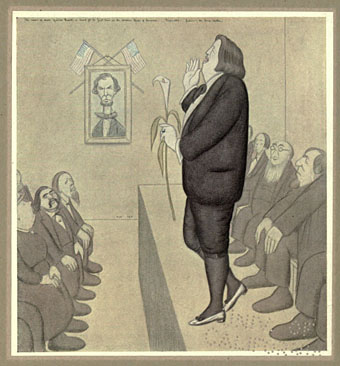
One of Beerbohm's favorite targets was the Pre-Raphaelite group. Here is Swinburne reading to the Rosetti Brothers:


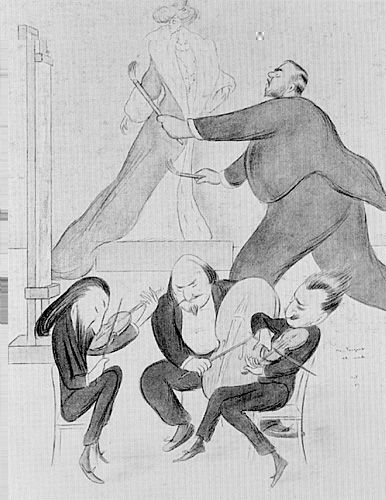
And a group caricature of the Rosetti Circle:


John Singer Sargent painting:


Here is a self-caricature of Max:


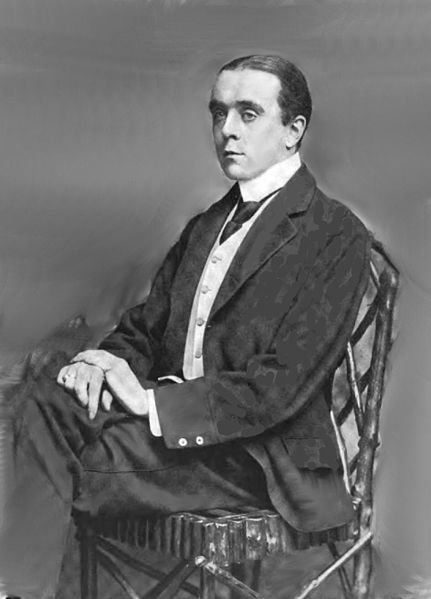
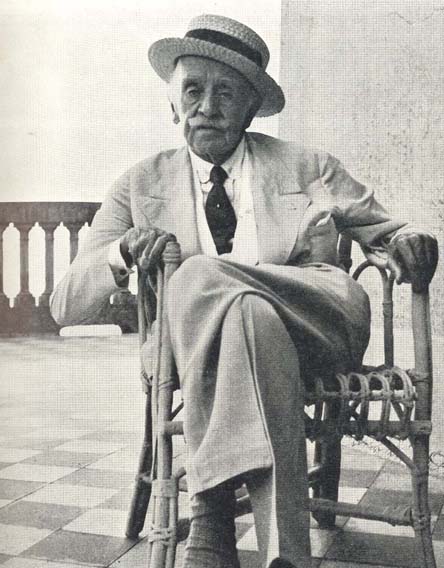
And a few photos of him, young and old:


Wednesday, February 1, 2012

The Chap: The Style of Politics

The following is an excerpt of an article I wrote for the Chap Magazine's February/March 2012 issue:

...When Winston Churchill dismissed Mohandas Gandhi as “a half-naked, seditious fakir,” Gandhi, rather than describe the Prime Minister as a bloated imperialist in pinstripes, explained that he wore his loincloth as “the symbol of India's distress.” The sans-culottes of the French Revolution took their name because they wore long pants rather than the fashionable knee-breeches of the bourgeoisie (two decades later, the arch-dandy Beau Brummell made long pants de riguer fashion throughout Europe.) In the English Civil War Parliamentarians were called “Roundheads” for their close-cropped hair, in contrast to the foppish curls of the Royalists, first as an epithet and then taken up by the Parliamentarians in defiance. The song “Yankee Doodle,” (one of the first recorded uses of the word dandy,) was originally sung by the red-coated British Soldiers (called “Lobsterbacks” by the colonists,) who mocked the colonists' slovenly appearance; saying they were stupid enough to think a feather could transform them into fashionable “Macaroni”-wigged dandies. The ragged Continental militias soon claimed the song as their own.
            A different sartorial radicalism is seen in the struggle for black civil rights. At the beginning of the 20th Century, a popular minstrel character was “The Dandy Colored Coon,” mocked for trying to dress above his station, looking ridiculous in a battered top hat, cracked monocle, and patched tailcoat. In subsequent years, entertainers like the immaculately-attired Duke Ellington - “Harlem's Aristocrat” - challenged this stereotype by dressing better than their white audiences.
            A crucial aspect of the protests of Martin Luther King was the assertion of dignity. For black Americans, whose ancestors had been sold naked as chattel, clothes were a symbol which affirmed their humanity. The image of black men and women in their Sunday best, led by Dr. King in his sack suit and fedora and Bayard Rustin in a thin knit tie and slim-lapel jacket, were striking. Malcom X, in his tab-collar shirt, tie clip, and sharp squared glasses looked like a serious-minded man who could cut you with the crease of his pants. These people demanded respect with their appearance and dignified manner...