Friday, September 21, 2012

Dandy Talk at the National Arts Club

On Friday, October 5th, I will be participating in a panel discussion on Dandysim at the National Arts Club. With me on the panel will be Rose Callahan of The Dandy Portraits, Matt Fox of the Fine and Dandy Shop, and manners expert Thomas P. Farley. There will be a reception with refreshments provided by Hendricks Gin and music provided by Dandy Wellington and his band. I hope you can come!


Friday, September 7, 2012

Arthur Cravan and the Oscar Wilde Hoax


I'm always thrilled to discover interesting sidebars in my dandy history, particularly when they connect various figures and themes. The dadaist poet, artist, and dandy Arthur Cravan was a notorious hoaxer - some even think he faked his death. What's more, he once challenged former world heavyweight champion Jack Johnson to a boxing match as an art project while the two of them were on the run: Cravan fleeing the draft in the First World War and Johnson fleeing prosecution for sex trafficking in the U.S. If that weren't amazing enough, Cravan was also Oscar Wilde's nephew. One can easily see why he was one of Marcel Duchamp's favorite people. Cravan once claimed that his uncle Oscar wasn't really dead and had, in fact, come to visit him in Paris. The papers were so desperate for juicy Wilde gossip that the New York Times even sent a special correspondent to Paris. The original article can be found in their online archives:


Tuesday, August 28, 2012

The Chap: The Prince of Whales


The following is an excerpt from an article I wrote for the Chap Magazine on the fat dandy Prince George IV:

...While the crowned heads of Europe were sweating at the thought of separation from their royal torsos, George IV, then Prince of Wales, saw a singular opportunity presented by the revolution in France. Along with the refugee noblemen arriving at Dover came some of the greatest unemployed chefs in all of Europe, and the hungry Prince was ready to put them through their paces. The aristocratic English diet at the time was centered on heroic portions of beef, and the Prince himself, in his typical pre-Brumellian attire of pink and white silk coats and waistcoats, spangled breeches, lacy-sleeved shirts, all embroidered with heraldic devices and flowers, dotted with silver and precious stones, and treated to generous applications of colorful foil, genuine diamonds, and French paste, attended regular dinners at Covent Garden’s  “Sublime Society of Beef-Steaks,” at which he and his vulgarian crew of noblemen would put away several pounds of cow flesh washed down with an ocean of arrack punch....
...It’s no wonder that by the age of fifty the Prince weighed 17 stone, ballooning to over 22 stone by the time he died. He did his best to control his 50-inch waist with whalebone corsets and stays, but it would seem that most of his astounding wardrobe, which included hundreds of suits, thousands of shirts, dozens of elaborate military uniforms, silk bathing gowns, white beaver robes for lounging, astrakhan caps in the Polish style, underpants of black silk, muffs made of Muscovy sable and sea otter, doeskin pantaloons, scarlet flannel waistcoats lined in calico, muslin-and-gold woven handkerchiefs costing about £1800 each at today’s rates, velvet nightcaps, boots with gold and silver tassels, and a dozen different jeweled eyeglass cases, along with thousands of snuffboxes, brooches, clasps, and rings, was outgrown at a ludicrous rate.The impression of a human disco ball – spherical and covered in diamonds – isn’t too far off from the truth. George, now King, spent his later years being helped into the ocean to bathe (infrequently,) by a lever and pulley-operated harness system installed at the Brighton Pavilion and shoved up ramps onto unfortunate horses in order to take exercise (even less frequently.)... 

Thursday, August 16, 2012

Adolf Loos


The English-language scholarship of dandyism has reason to rejoice: Metroverlag press has released an English compilation of some of Adolf Loos' writings on clothing: "Adolf Loos: Why A Man Should Be Well Dressed." The translation reads nicely, although there are some typos and grammatical errors. Loos was an Austrian architect working in fin de siecle Vienna who advocated an aesthetic simplicity which prefigured the modern schools such as Bauhaus and De Stijl. His most famous work is the essay "Ornament and Crime," in which he vents his spleen upon helpless flower boxes on windowsills. His sartorial philosophy is equally uncompromising and austere, based on his forward-thinking and somewhat utilitarian ideas about form following function. His idea of "dandies" come in for a drubbing in the essays, but Loos himself found much common ground in Beau Brummell's classic idea of dandyism - an emphasis on simple and refined elegance over ostentation, ornamentation, and flamboyance. Below are some photographs I took at Loos' famous "American Bar" while researching his life in Vienna.


Monday, August 6, 2012

The Chap: Lesser-Known Dandies

The following are some excerpts from an article I wrote on lesser-known dandies for The Chap Magazine:

...Robert Coates, son of a wealthy English sugar planter in Antigua, came to England with dreams of being an actor. But before Coates ever took to the boards, he made his theatrical debut on the streets of London, glittering from boot to hat in his heirloom diamonds and, when not marching around town with the proud stride of a man trying to catch up with his nose, riding in a two-seater open-topped chariot – the convertible of its day. The vehicle was gilded and shaped like a clam, and he sat up in it, Venus-like, and looked out over the giant silver-plated rooster affixed to the yoke....
...Evander Berry Wall was a New York Gilded Age socialite who boasted that he'd gambled away two million-dollar inheritances speculating on horseflesh at racetracks around the world. His memoir is a catalog of million-dollar friends, thousand-dollar dinners, and long nights spent in champagne-soaked evening clothes...Wall wore mad plaids and was famous for owning 5000 neckties, which he wore “a yard long, wound around twice, and knotted into a bow.”

......[Jacque] Rigaut’s obsession was suicide, a fixation and artistic calling which remained with him until the day he died. He declared with proud Wildean flippancy that “suicide should be a vocation,” and then worked at it until an early retirement at the age of 30...His oeuvre is suitably slim for an obscure dandy, but his legacy in this grand company is assured with the boastfully immortal words: “Try, if you can, to arrest a man who travels with suicide in his buttonhole.”...

Monday, July 30, 2012

Oscar Wilde's Hair


We may quite rightly bemoan today's celebrity culture and the complicity and laziness of the media in regurgitating one another's stale tidbits of gossip, but one should note that on January 7, 1886 the New York Times thought that the following was important enough to reprint from London's Figaro newspaper:

Mr. Oscar Wilde, much to the chagrin of his more thoroughgoing followers, still persists in wearing his hair cut short. Both in look and costume indeed he is so altered for the better that the name - prematurely given him by a satiric journal- of Oscar Tame would now fit him like a glove.

One should note that Wilde, in great dandy style, was original and always ready to confound his critics by doing the unexpected - when his long hair became a cliche, he simply cut it off so that he couldn't be so easily caricatured as the languid, supra-bohemian aesthete. 

Wednesday, July 4, 2012

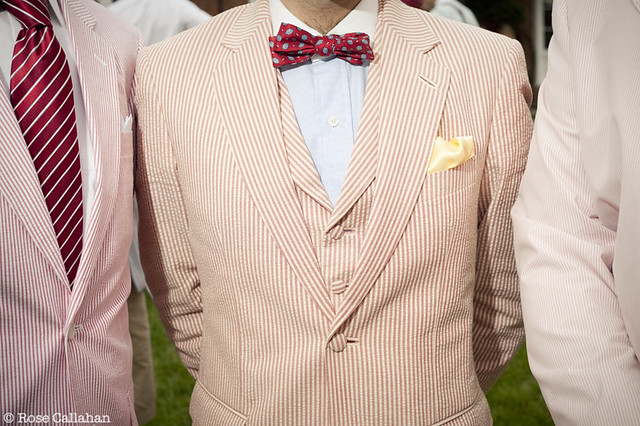
The Chap: Seersucker Social

The following is an excerpt from an article I wrote for The Chap magazine about Washington D.C.'s Dandies and Quaintrelles 2011 Seersucker Social. The beautiful photographs are provided by Rose Callahan of The Dandy Portraits:


...For the Capitol city of a superpower nation, Washington DC is sadly insular, non-cosmopolitan, and aesthetically conservative. The suits are gray or navy, the ties are red or blue, and not since the pith-helmeted and moustachioed Teddy Roosevelt has a president looked like anything other than a businessman. The summer heat can be stifling, adding to the soporific atmosphere of the city.
            It was with the admirable aim of introducing his notoriously staid home city to a form of more “refined leisure” that Eric Brewer founded Dandies & Quaintrelles. The group is dedicated to organizing events which embody an egalitarian elegance worthy of the Bill of Rights...
...Seersucker is by no means a new addition to the pantheon of summer fabrics. The word arrived in the English Language from the Hindi sirsakar, which in turn got it from the Persian shiroshakar, by way of Tamerlane's 14th-century invasion. The original means “milk and sugar,” a reference to the alternating textures of the puckered stripes of cotton. The fabric is most commonly found in white with another color in eighth-inch vertical Bengal stripes. It is less frequently found in gingham checks, and I once nearly fainted in admiring awe at a white-on-white striped seersucker dinner jacket with a built-up linen shawl collar and turn-back cuffs. Because the fabric is so light and crisp (holding a crease much better than plain linen,) it's perfect for summer suits, usually half-lined......At the very start of the twentieth century, seersucker began its journey to become one of this country's best-loved fabrics. Although the British wore seersucker in the empire's equatorial colonies, its popularity boomed in the heat of the American South. It soon became a staple of the Southern Gentleman's wardrobe, and the traditional uniform for going to the Kentucky Derby, getting tanked on Mint Juleps, and losing your son's college fund on a long-shot. The fabric later gained in popularity when those sly young Ivy-Leaguers appropriated the garments as separate pieces rather than full suits. 
Even the hallowed halls of the Senate occasionally see seersucker. Once a year, both lady and gentleman Senators celebrate Seersucker Thursday, a tradition started by Republican Senator Trent Lott. The event harks back to a time before air-conditioning, when the heat was so punishing that sweat-covered legislators, probably driven mad, did things like enact prohibition....