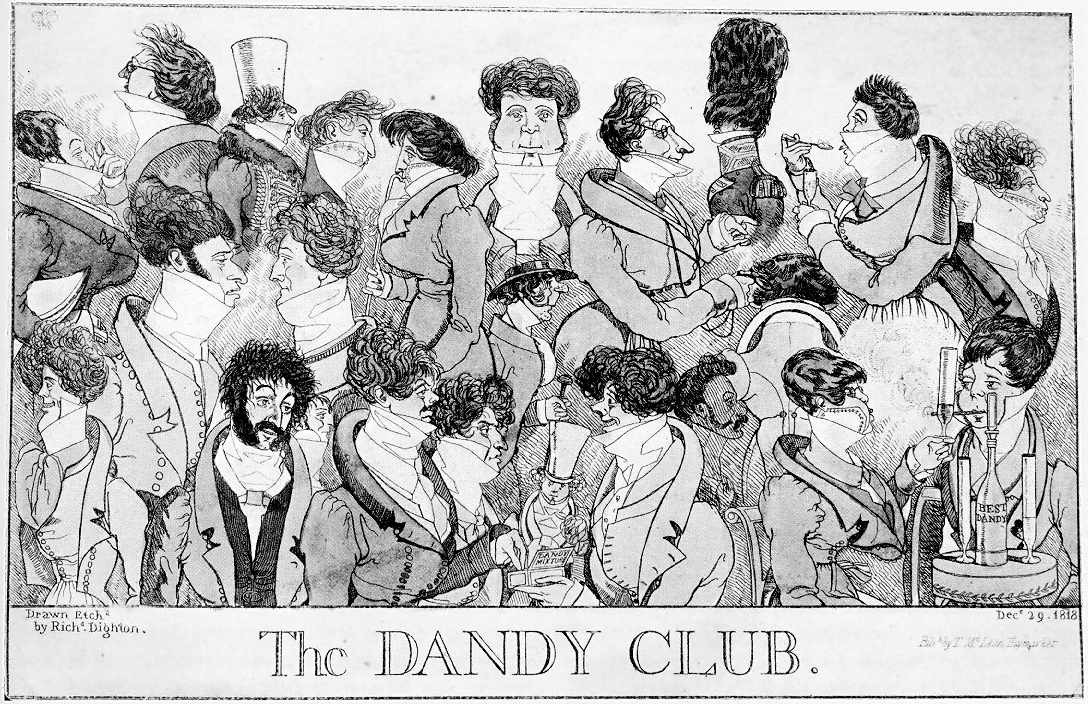
Tuesday, November 27, 2012

Dandies and Aesthetes


Last week I visited a seminar course on Oscar Wilde at New York University to speak about dandyism with the students. It was an excellent opportunity for me to hear from students of the humanities who had read the foundational texts of dandyism (D’Aurevilly’s “On Dandyism,” excerpts from Baudelaire’s “The Painter of Modern Life,” and Max Beerbohm’s “Dandies and Dandies,”) rather than just people with an interest in menswear. I had also resolved to answer any of their less typical questions on this blog, and one in particular stood out: the relationship and difference between dandyism and aestheticism. The fact that I had a dream last night about searching for a full-length oil painting of arch-Aesthete Harold Acton encouraged me to give the question some thought today.

            Dandyism and Aestheticism are both personified in the public mind no more so than in the person of Oscar Wilde. By the time Wilde had first found fame, “dandy” had become an inconsequential term, mostly used dismissively and in its most colloquial sense to mean a man obsessed with the triviality of clothing and possessed of a flippant and unserious attitude. It was as a great aesthete that Wilde first won renown – by the time he had left Oxford he had gained notoriety for cooly remarking that he was trying to live up to his China, and the image of the towering Wilde in silk stockings and knee-breeches, mincing down the street clutching a sunflower, was a favorite of caricaturists on both sides of the Atlantic. Wilde’s aestheticism, inspired by his two professors, Walter Pater (who had a Romantic idea about the sublimity of art and said that one’s life should “burn with a hard, gem-like flame,”) and John Ruskin (who believed in the moral and spiritual force of art,) was so well known and easily-lampooned that Gilbert and Sullivan wrote the operetta Patience satirizing the aesthetic movement, with broadly-drawn characters based on Wilde and James McNeill Whistler.

            The incredible success of Patience in England led to the play’s producer hiring Wilde to go on an extensive lecture tour of America in advance of its stateside opening. The audiences went mad for Oscar Wilde, the famous aesthete, with his velvet clothes, mellifluous voice, and purple musings. Wilde lectured on the importance of beauty – on beauty being an end in itself, life’s ultimate goal, in anything from speech to wardrobe to home décor. Some of the listeners ate his philosophy up with a beautifully-wrought spoon, but most of them found his pontifications more than a little ridiculous. At Harvard a group of undergraduates entered the hall in mid-lecture dressed as they had imagined Wilde to be, and sauntered to their front-row seats, nose in air. At another University, an even crueler gang of kids put ill-fitting evening clothes on a black vagrant and paid him to dance up the aisle swinging a bouquet of lilies. In both instances, Wilde confounded them by appearing in immaculate evening dress rather than the neo-Renaissance garb they had expected, brushing their insults off like lint.

            I think that Wilde, who knew better than anybody the pitfalls of being earnest, realized that he couldn’t be an aesthete with too straight a face. The majority of the public couldn’t stand for too much rhapsodizing without a modicum of irony – and that’s when Wilde truly combined the aesthete and the dandy. The dandy’s insouciant charm and unflappability were powerful when wedded to the aesthete’s glorifying mission. If the audience seemed determined to take the aesthete’s artistic prescriptions with a grain of salt, the dandy would force it all down with a lump of sugar served with a cheeky wink. Wilde was a dandy by nature, and an aesthete at least partly by education. He needed to leaven the seriousness of aestheticism with the wit of the dandy, something his professors, in their noble earnestness, had never managed to do.

            The most important distinction between Dandyism and Aestheticism, however, isn’t simply their level of seriousness – it is, in fact, something much more fundamental than that. Aestheticism is a philosophy, a guiding belief chosen, if not always rationally, then at least intentionally. The follower of aestheticism has studied his subject and come to the conclusion that art is paramount in life and beauty paramount in art. Dandyism, on the other hand, is far closer to a compulsion than it is a philosophy. It is an obsession, more often than not irrational, and occasionally bordering on a psychological disorder. The true dandy cannot behave any other way. Like homosexuality, dandyism is rarely a choice and its practitioners must live by its dictates or be doomed to a life of hypocrisy, unhappiness, and the secret suffering of the underdeveloped and unfulfilled, to say nothing of cargo shorts, Croc shoes, and baseball caps. A dandy unable to be a dandy would atrophy and die, which is exactly why one sees dandyism appearing in the most unlikely of places and in the most difficult of circumstances, defeating capricious circumstance – it cannot be easily squelched.

            So much for the difference between dandyism and aestheticism; is there a relationship? Absolutely. And Wilde is, once again the man who was its most elegant embodiment. Put succinctly, one doesn’t have to be a dandy in order to be an aesthete and vice-versa. But aestheticism seems to be the perfect philosophy for someone afflicted with dandyism, and dandyism, considered as an innate compulsion, seems to be a natural encourager of aestheticism.

            Wilde wasn’t the only dandy-aesthete. The Twentieth Century’s greatest champion of Aestheticism was also an accomplished dandy, particularly when he was young. Harold Acton opens his famous Memoirs of an Aesthete with a defiant proclamation:
“Half of my friends disapprove of the title I have chosen for this book without having read it. ‘What! an aesthete? One of those scruffy long-haired fellows in peculiar garb, lisping about art for art’s sake? No, no. You’ll prejudice all your readers in advance. Old Oscar screwed the last nail in the aesthete’s coffin’…
Though I shiver and cough I refuse to be a pessimist. We had a culture which war has interrupted, and it was nourished by a few people like myself, citizens of the world. During the war we were forced into hibernation. Many of us are hibernating still.
We citizens of the world are neither famous nor spectacular. But there is a slow fire burning within us, and it is time for our latent energies to swell forth anew. It is time for us to reassert ourselves. And it is our duty to remind our fellow creatures of what they are fast forgetting, that true culture is universal…
Without apologies then, and without being a laudatory temporis Actoni, let me glory in the name of aesthete, for I am one in the proper sense of that word. Let me fling it in the teeth of the Philistines!”
I'll leave you with Acton's impression, when he first came to Oxford and encountered what passed for aestheticism there, a vision not unfamiliar to anyone who’s met a steampunky gothic Morrissey fan clutching a copy of Dorian Gray:
“Lunching with Billy Clonmore, I met what he described as ‘an aesthete’ and was disconcerted.  A pressed fern from the pages of the Yellow Book, his disjointed fragments of drawled conversation were as dull as his jaundiced eyes. Had he taken an active interest in the ‘nineties, I might have excused his jaded mannerism. But what interest he could muster in life was limited to his sickly appearance. Sensing my indifference, if not my antipathy, he showed me, in an offhand conceited way, some etchings he had picked up in Vienna. They were timidly prurient, meretriciously art-and-crafty. My gorge rose, my indignation whetted by the creature’s pretension to taste, and I was goaded to crude rudeness. ‘Your etchings are the messes of a miserable masturbator,’ I told him.
There was already sufficient prejudice against art in England, and I feared that this type – for he was a type – was damaging a cause I cherished. He was sterile to the core. His long hair and his ebony cane only stressed his lack of personality. If others could not bear the sight of him – which was evident as we were walking down the Broad – neither could I. Better the moustache stained with nicotine! Billy said he wasn’t such a bad soul. ‘I wouldn’t mind so much,’ I expostulated, ‘if he were a bad soul, if he had anything to positive as a vice.’ I left Billy’s luncheon bursting with resolutions. I made up my mind that if that eunuch represented Oxford aestheticism something would have to be done about it soon. Now that the war was over, those who loved beauty had a mission, many missions. We should combat ugliness; we should create clarity where there was confusion; we should overcome mass indifference; and we should exterminate false prophets.”

Wednesday, October 24, 2012

The Chap: Bohemians

In the latest issue of The Chap, I discuss bohemianism - the ultimate anti-dandyism. Below is a small excerpt.


As the great decadent siècle came to its fin, the influence of the dandies had waned. Oscar’s ignominious tumble down the ladder leading from stars back to gutter had soiled the archetypal aesthete’s velvet reputation – to be an elegant man was to be suspect, to be an elegant artist unconscionable. So it was that a new generation of poetry and paint-brush poseurs had to forge a new fashion which bespoke their anti-establishment attitudes. The green carnation in one’s lapel was old hat sartorial subversion – the new subversion required actual old hats, preferably big floppy ones of Continental provenance.
Into this tightly-laced world leapt the Bohemians with gypsy-inspired bravado. Their de facto suzerain, the painter Augustus John, led the way:
 But now a new kind of exhibitionism was born; in its way, as exact and conscientious as my father’s cult of the clothes-brush; a kind of inverted Dandysim. If my shoes were unpolished, they were specially made to my own design. If I abjured a collar, the black silk scarf that took its place was attached with an antique silver brooch which came from Greece. The velvet additions to my coat were no tailor’s but my own afterthought, nor were my gold earrings heirlooms, for I bought them myself: the hat I wore, of a quality that only age can impart…My abundant hair and virgin beard completed an ensemble which, if harmonious in itself, often failed to recommend me to strangers. 

Friday, October 12, 2012

Whose Dandyism?


Jules Barbey D'Aurevilly, the first man to put on paper a critical analysis of dandyism as a cultural phenomenon opens one of the chapters of his work On Dandyism and George Brummell with the frank admission that "Dandysim is almost as difficult a thing to describe as it is to define." This difficulty, at once one of the most intriguing and frustrating things about studying dandyism, has persisted and animated the pens of writers as diverse and accomplished as Baudelaire, Virginia Woolf, Cyril Connolly, and W.H. Auden.

D'Aurevilly, as the title of his essay-cum-biography suggests, took Brummell as his main subject, holding him up as the prime example of a dandy and therefore the embodiment of dandyism as an idea realized. He was not wrong in doing this, although one trap D'Aurevilly never fell into was to assume the fallacy that because Beau Brummell was the ideal dandy all other dandies must therefore follow the style of Beau Brummell. This yawning logical gap neatly avoided by the thoughtful and observant Frenchman has all too often been leapt across (back and forth and back again without the least attempt at original thinking,) by those who would, 200 years after Brummell, declare that dandyism must follow the sartorial principles laid down by that prime mover. There could hardly be anything less dandyish (or more humorless,) than such undeviating idolatry, and one would hope that anyone as spirited and clever as the Beau would have little regard for those who would hold so fast and dearly to what was, at the time, a fiercely independent style.

"Dandyism" is not a synonym for Beau Brummell's personal sartorial philosophy or taste. He did not proselytize like some stylish messiah, telling people that he had developed a creed called dandyism and there was a proper way to practice, preach, and worship it. Dandy was a name other people gave to Brummell (as well as plenty of other men at the time whose individual style bore little resemblance to the Beau's elegance-through-simplicity,) and dandyism was a term that was used to refer to a considerably broader set of ideas than Brummell's own notions about the proper way to dress. Brummell is the exemplar of dandyism not because he was objectively the best dressed (although he may well have been,) or because his own personal style was the correct way to dress (although it may well have been,) but because he was the most radical in his style, the most original in his lifestyle and personality, and the most successful in its promotion.

Brummell's oft-quoted remark that "If John Bull turns round to look after you, you are not well dressed: but either too stifftoo tight, or too fashionable," is an excellent summation of his own professed sartorial philosophy (albeit clearly tongue-in-cheek if not a downright lie - Brummell quite obviously did want people to turn to look at him and this was exactly the kind of flippant remark he was fond of making without really meaning,) and it makes reference to one of the key elements of dandyism - that style is more important than fashion. But it is not a definition of dandyism by any means and it is certainly not a dogmatic rule that could stand up on its own 200 years later. If this alone were the definition of dandyism, applied today it would form a loop big enough to accommodate any man in a nicely-cut but determinately not-flashy suit - from James Bond to David Beckham. Not only that, but it would exclude many of the men who came after Brummell and who are now widely considered to be dandies: Count D'Orsay, Baudelaire, Count Montesquiou, Oscar Wilde, Max Beerbohm, Gabriele D'Annunzio, Stephen Tennant, Cecil Beaton, Evander Berry Wall, Lucius Beebe, Bunny Roger, and Tom Wolfe. It seems to me that any definition which would exclude such men for their sometime-flamboyance isn't a definition worth having. 

It is true that Brummell's own style was notable for its restraint, simplicity, and anti-flamboyance. It may have been a style which favored subtlety, but this doesn't mean that it was, relatively speaking, a subtle style. It was, in fact, impressive, radical, and aggressive in its simplicity - a stunning reaction to the foppery of his time. Studying Brummell's life, there's every reason to suspect that if he had arrived at a time when the fashion was to dress in a subdued or restrained manner he would have pursued a bolder aesthetic in his own dress. 

Defining what dandyism is is a much greater task - one which I hope to achieve in my book. To be sure, dandyism is about dressing well and pursuing a life of elegance, wit, and originality. But one thing it certainly isn't is an unwavering allegiance to Brummell's (or Wilde's, or Loos', or Horsely's) personal ideas about clothing. Dandyism is a far too great subject to be reduced to one man's thoughts about dress. Rather, it is partly a way of thinking about dress - or, more specifically, the belief that dress is something which should be carefully thought about, with beauty, elegance, and originality as paramount considerations. And one should never forget that dress is only one criteria of dandyism and that a monkey in a suit - or David Beckham - will never truly be a dandy. 

Despite all my kvetching about arguments from two century-old authority I'll still let D'Aurevilly have the last word:

"Those who see things only from a narrow point of view have imagined [dandyism] to be especially the art of dress, a bold and felicitous dictatorship in the matter of clothes and exterior elegance. That it most certainly is, but much more besides. Dandyism is a complete theory of life and its material is not its only side. It is a way of existing, made up entirely of shades, as is always the case in very old and very civilized societies, where comedy becomes so rare, and the properties hardly have the better of boredom."    

Tuesday, October 9, 2012

The Book Covers of Louis Couperus

One of the most pleasant things about doing historical research is finding one's way down paths known only to locals. While taking a break from my research in London, I visited a friend of mine in Amsterdam for a week, expecting to find rather dandy-free diversions while there. The funny thing about obsessions is that they linger in the air around you, attracting their own kind. One night I ended up in an attic garret with a group of philosophy students from the local university, who were drinking wine, smoking hashish, and reciting poetry to one another. One young man, who was reciting some lines particularly violently, explained to me afterward that they were by Louis Couperus - a famous Dutch writer whose work is sadly overlooked outside his native country. Couperus was active during the belle époque, and was compared by many to Oscar Wilde, who was a fan of his. Several of his works are available in English translation at Gutenberg.org.

But what I wanted to share are the beautiful book covers of some of his first editions, which are on Couperus' Wikipedia page. I hope my book looks this nice.


Monday, October 8, 2012

Dandy Talk Success


Last friday I took part in a panel discussion on Dandysim at the National Arts Club. The panel was moderated by Emmy Award-winning designer David Zyla, and featured Rose Callahan of The Dandy Portraits, Matt Fox of the Fine and Dandy Shop, and manners expert Thomas P. Farley.

Rose has posted several photos on the Dandy Portraits blog.

The event was the most popular installment so far of the friday fashion discussions which Mr. Zyla has been organizing - the Club was overbooked with RSVPs and a waiting list nearly as long as the guest list itself. The audience, as can be seen in the event photos posted on The Dandy Portraits blog, was incredibly stylish.

Before the talk, Rose screened her excellent video about necktie designer extraordinaire Sean Crowley.

The talk itself was only forty minutes long, and there were four panelists, so we each only got to speak a little bit, but the discussion was lively, and the questions from the audience were particularly good - questions about race, class, gender, and the relative importance of vintage/retro/nostalgia. After I shut down a question about the possibility of female dandies with the reply "no," my mother raised her hand to ask us to elaborate because she didn't want to let me off the hook that easily.

The Fine Young Gentleman blog posted about the event here, and even put up an audio recording of the talk. (My favorite part of his writeup is obviously: 'The most memorable quote from the night came from Mr. Adams when he noted that “I think that probably the only people who wore bowties for years was the Nation Of Islam, they might have accidentally kept Brooks Brothers in business.”')

After the talk, we were treated to fantastic jazz by Dandy Wellington and his band.

Friday, September 21, 2012

Dandy Talk at the National Arts Club

On Friday, October 5th, I will be participating in a panel discussion on Dandysim at the National Arts Club. With me on the panel will be Rose Callahan of The Dandy Portraits, Matt Fox of the Fine and Dandy Shop, and manners expert Thomas P. Farley. There will be a reception with refreshments provided by Hendricks Gin and music provided by Dandy Wellington and his band. I hope you can come!


Friday, September 7, 2012

Arthur Cravan and the Oscar Wilde Hoax


I'm always thrilled to discover interesting sidebars in my dandy history, particularly when they connect various figures and themes. The dadaist poet, artist, and dandy Arthur Cravan was a notorious hoaxer - some even think he faked his death. What's more, he once challenged former world heavyweight champion Jack Johnson to a boxing match as an art project while the two of them were on the run: Cravan fleeing the draft in the First World War and Johnson fleeing prosecution for sex trafficking in the U.S. If that weren't amazing enough, Cravan was also Oscar Wilde's nephew. One can easily see why he was one of Marcel Duchamp's favorite people. Cravan once claimed that his uncle Oscar wasn't really dead and had, in fact, come to visit him in Paris. The papers were so desperate for juicy Wilde gossip that the New York Times even sent a special correspondent to Paris. The original article can be found in their online archives: