Showing posts with label oscar wilde. Show all posts

Tuesday, September 12, 2017

The Temple of Oscar Wilde


The other night I attended the opening of McDermott & McGough’s Temple of Oscar Wilde at the Church in the Village. The installation is the realization of an idea the artists first had twenty five years ago and have spent the past few years building. 

The temple is a Catholic-style chapel, its centerpiece a four-foot carved wood sculpture of Wilde at the height of his velvet-clad long-haired fame. At the base of the statue’s plynth is a soapbox pulpit bearing a label for “fairy” brand soap. On the walls of the chapel are paintings of Wilde’s own stations of the cross, each with gilt-painted haloes and details like quatrocento icons. The scenes include Wilde’s arrest, the auction of his belongings, the cutting of his hair, and his time in Reading Gaol, among other things. 

In addition to this the chapel has a guest book, a section of line portraits of LGBT martyrs including Harvey Milk and Alan Turing, a candle-lit collection stand for homeless LGBT youth, and a book of remembrance in which guests can write the names of those who died of aids. Same-sex weddings will also be held in the temple. 

To portray Wilde as a gay icon, saint, and martyr is not uncommon. His arrest, downfall, and ignominy, coming at the end of the 19th century, set the tone for the particular style of homophobia that would dominate the 20th. Despite being a six-foot-plus bruiser of a man, Wilde’s fashion sense, delicacy of taste, refined sensibilities, and sharp wit would come to define the queer male archetype in the public consciousness, recast as vanity, effeminacy, flamboyance, and camp. 

The irony of placing Wilde at the center of a chapel isn’t lost. It was the doctrine of the Church of England, informing the law of the state regarding sexual relations, that lay at the heart of Wilde’s persecution. Wilde himself converted to Catholicism on his death bed, having always been fascinated by and attracted to the church’s iconography, sumptuousness, and sensuality, and seeing in that church’s bloody image of Christ the sufferer something of his own crucifixion. Of course, perhaps no church has burned more gay men than the Roman one while at the same time indulging in the hypocrisy of “hate the sin love the sinner,” a deeply closeted clergy, highly homoerotic imagery like the martyrdom of St. Sebastian, and of course, the unforgivable decades (centuries?) of the rape of children by those tasked with their spiritual health. 

Its perhaps the installation’s emphasis on young people that gives it its most power, as well as its inclusion of lesbian, bisexual, and transgender martyrs - as well as people of color - in its pantheon. In the past Wilde was chiefly a symbol for gay white men, but McDermott & McGough’s version of the deity is a more inclusive one. I hope that young people of all sexualities and backgrounds will gain an appreciation for Wilde’s importance and meaning by visiting the temple. 

That legacy is one not just of gay rights, but of a profound capacity for love and compassion. Wilde was “Christian” in the most generous sense of the word, capable of great understanding and empathy in a way that the chauvinistic and patriarchal christianity of the Victorian empire could only pretend to be. His deep personal knowledge and experience of suffering informed his own personal theology, and he was almost miraculously able to take from his own ordeal a greater sense of love and forgiveness. Its a nearly superhuman feat, one which organized religion stumbles over on a large scale. It is personal and generous, and it demands no superstition or obeisance to authority - its mandate is a deep love for and patience with humanity and reverence for its ability to improve. 

If only there could be more altars to secular heroes and people of great spirit like Wilde - monuments stripped of medievalism and consecrated to the humanistic spirit. We have McDermott & McGough to thank for this one. 

I’ll end with two Wilde-related poems. The first, “Narcissus” by John Betjeman, always has me weeping halfway through, mainly because it so heartbreakingly shows how the short-sightedness, hang-ups, and prejudices of adults are inflicted upon the innocence of childhood. 

Narcissus

Yes, it was Bedford Park the vision came from - 
de Morgan lustre glowing round the hearth,
And that sweet flower which self-love takes its name from
Nodding among the lilies in the garth,
And Arnold Dolmetsch touching the spinet,
And Mother, Chiswick’s earliest suffragette.

I was a delicate boy - my parents’ only - 
And highly strung. My father was in trade. 
And how I loved, when Mother left me lonely,
To watch old Martha spice the marmalade,
Or help with flower arrangements in the lobby
Before I went to find my playmate Bobby.

We’d go for walks, we bosom boyfriends would
(For Bobby’s watching sisters drove us mad),
And when we just did nothing we were good,
But when we touched each other we were bad.
I found this out when Mother said one day
She thought we were unwholesome in our play.

So Bobby and I were parted. Bobby dear,
I didn’t want my tea. I heard your sisters
Playing at hide-and-seek with you quite near
As off the garden gate I picked the blisters.
Oh tell me, Mother, what I mustn’t do - 
Then, Bobby, I can play again with you.

For I know hide-and-seek’s most secret places
More than your sisters do. And you and I
Can scramble into them and leave no traces,
Nothing above us but the twigs and sky,
Nothing below us but the leaf-mould chilly
Where we can warm and hug each other silly.

My Mother wouldn’t tell me why she hated
The things we did, and why they pained her so.
She said a fate far worse than death awaited
People who did the things we didn’t know,
And then she said I was her precious child,
And once there was a man called Oscar Wilde.

‘Open your story book and find a tale
Of ladyes fayre and deeds of derring-do,
Of good Sir Gawaine and the Holy Grail,
Mother will read her boy a page or two
Before she goes, this Women’s Suffrage Week,
To hear that clever Mrs Pankhurst Speak.

Sleep with your hands above your head. That’s right - 
And let no evil thoughts pollute the dark.’
She rose, and lowered the incandescent light.
I heard her footsteps die down Bedford Park.
Mother where are you? Bobby, Bobby, where?
I clung for safety to my teddy bear.

The second poem is A.E. Housman’s “Oh Who is that Young Sinner,” a well-known piece written after Wilde’s arrest but not released until after Housman’s death. Like most of Housman, it has a  countryside sing-song economy that bears a deceptively heavy message. 

Oh Who Is That Young Sinner

Oh who is that young sinner with the handcuffs on his wrists?
And what has he been after that they groan and shake their fists?
And wherefore is he wearing such a conscience-stricken air?
Oh they're taking him to prison for the colour of his hair.

'Tis a shame to human nature, such a head of hair as his;
In the good old time 'twas hanging for the colour that it is;
Though hanging isn't bad enough and flaying would be fair
For the nameless and abominable colour of his hair.

Oh a deal of pains he's taken and a pretty price he's paid
To hide his poll or dye it of a mentionable shade;
But they've pulled the beggar's hat off for the world to see and stare,
And they're haling him to justice for the colour of his hair.

Now 'tis oakum for his fingers and the treadmill for his feet
And the quarry-gang on Portland in the cold and in the heat,
And between his spells of labour in the time he has to spare

He can curse the God that made him for the colour of his hair.

Tuesday, November 27, 2012

Dandies and Aesthetes


Last week I visited a seminar course on Oscar Wilde at New York University to speak about dandyism with the students. It was an excellent opportunity for me to hear from students of the humanities who had read the foundational texts of dandyism (D’Aurevilly’s “On Dandyism,” excerpts from Baudelaire’s “The Painter of Modern Life,” and Max Beerbohm’s “Dandies and Dandies,”) rather than just people with an interest in menswear. I had also resolved to answer any of their less typical questions on this blog, and one in particular stood out: the relationship and difference between dandyism and aestheticism. The fact that I had a dream last night about searching for a full-length oil painting of arch-Aesthete Harold Acton encouraged me to give the question some thought today.

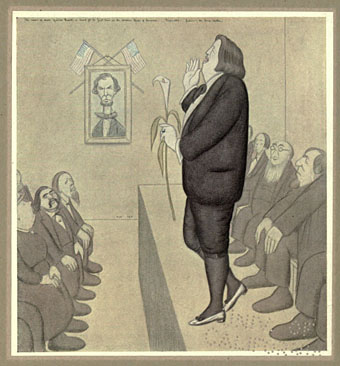
            Dandyism and Aestheticism are both personified in the public mind no more so than in the person of Oscar Wilde. By the time Wilde had first found fame, “dandy” had become an inconsequential term, mostly used dismissively and in its most colloquial sense to mean a man obsessed with the triviality of clothing and possessed of a flippant and unserious attitude. It was as a great aesthete that Wilde first won renown – by the time he had left Oxford he had gained notoriety for cooly remarking that he was trying to live up to his China, and the image of the towering Wilde in silk stockings and knee-breeches, mincing down the street clutching a sunflower, was a favorite of caricaturists on both sides of the Atlantic. Wilde’s aestheticism, inspired by his two professors, Walter Pater (who had a Romantic idea about the sublimity of art and said that one’s life should “burn with a hard, gem-like flame,”) and John Ruskin (who believed in the moral and spiritual force of art,) was so well known and easily-lampooned that Gilbert and Sullivan wrote the operetta Patience satirizing the aesthetic movement, with broadly-drawn characters based on Wilde and James McNeill Whistler.

            The incredible success of Patience in England led to the play’s producer hiring Wilde to go on an extensive lecture tour of America in advance of its stateside opening. The audiences went mad for Oscar Wilde, the famous aesthete, with his velvet clothes, mellifluous voice, and purple musings. Wilde lectured on the importance of beauty – on beauty being an end in itself, life’s ultimate goal, in anything from speech to wardrobe to home décor. Some of the listeners ate his philosophy up with a beautifully-wrought spoon, but most of them found his pontifications more than a little ridiculous. At Harvard a group of undergraduates entered the hall in mid-lecture dressed as they had imagined Wilde to be, and sauntered to their front-row seats, nose in air. At another University, an even crueler gang of kids put ill-fitting evening clothes on a black vagrant and paid him to dance up the aisle swinging a bouquet of lilies. In both instances, Wilde confounded them by appearing in immaculate evening dress rather than the neo-Renaissance garb they had expected, brushing their insults off like lint.

            I think that Wilde, who knew better than anybody the pitfalls of being earnest, realized that he couldn’t be an aesthete with too straight a face. The majority of the public couldn’t stand for too much rhapsodizing without a modicum of irony – and that’s when Wilde truly combined the aesthete and the dandy. The dandy’s insouciant charm and unflappability were powerful when wedded to the aesthete’s glorifying mission. If the audience seemed determined to take the aesthete’s artistic prescriptions with a grain of salt, the dandy would force it all down with a lump of sugar served with a cheeky wink. Wilde was a dandy by nature, and an aesthete at least partly by education. He needed to leaven the seriousness of aestheticism with the wit of the dandy, something his professors, in their noble earnestness, had never managed to do.

            The most important distinction between Dandyism and Aestheticism, however, isn’t simply their level of seriousness – it is, in fact, something much more fundamental than that. Aestheticism is a philosophy, a guiding belief chosen, if not always rationally, then at least intentionally. The follower of aestheticism has studied his subject and come to the conclusion that art is paramount in life and beauty paramount in art. Dandyism, on the other hand, is far closer to a compulsion than it is a philosophy. It is an obsession, more often than not irrational, and occasionally bordering on a psychological disorder. The true dandy cannot behave any other way. Like homosexuality, dandyism is rarely a choice and its practitioners must live by its dictates or be doomed to a life of hypocrisy, unhappiness, and the secret suffering of the underdeveloped and unfulfilled, to say nothing of cargo shorts, Croc shoes, and baseball caps. A dandy unable to be a dandy would atrophy and die, which is exactly why one sees dandyism appearing in the most unlikely of places and in the most difficult of circumstances, defeating capricious circumstance – it cannot be easily squelched.

            So much for the difference between dandyism and aestheticism; is there a relationship? Absolutely. And Wilde is, once again the man who was its most elegant embodiment. Put succinctly, one doesn’t have to be a dandy in order to be an aesthete and vice-versa. But aestheticism seems to be the perfect philosophy for someone afflicted with dandyism, and dandyism, considered as an innate compulsion, seems to be a natural encourager of aestheticism.

            Wilde wasn’t the only dandy-aesthete. The Twentieth Century’s greatest champion of Aestheticism was also an accomplished dandy, particularly when he was young. Harold Acton opens his famous Memoirs of an Aesthete with a defiant proclamation:
“Half of my friends disapprove of the title I have chosen for this book without having read it. ‘What! an aesthete? One of those scruffy long-haired fellows in peculiar garb, lisping about art for art’s sake? No, no. You’ll prejudice all your readers in advance. Old Oscar screwed the last nail in the aesthete’s coffin’…
Though I shiver and cough I refuse to be a pessimist. We had a culture which war has interrupted, and it was nourished by a few people like myself, citizens of the world. During the war we were forced into hibernation. Many of us are hibernating still.
We citizens of the world are neither famous nor spectacular. But there is a slow fire burning within us, and it is time for our latent energies to swell forth anew. It is time for us to reassert ourselves. And it is our duty to remind our fellow creatures of what they are fast forgetting, that true culture is universal…
Without apologies then, and without being a laudatory temporis Actoni, let me glory in the name of aesthete, for I am one in the proper sense of that word. Let me fling it in the teeth of the Philistines!”
I'll leave you with Acton's impression, when he first came to Oxford and encountered what passed for aestheticism there, a vision not unfamiliar to anyone who’s met a steampunky gothic Morrissey fan clutching a copy of Dorian Gray:
“Lunching with Billy Clonmore, I met what he described as ‘an aesthete’ and was disconcerted.  A pressed fern from the pages of the Yellow Book, his disjointed fragments of drawled conversation were as dull as his jaundiced eyes. Had he taken an active interest in the ‘nineties, I might have excused his jaded mannerism. But what interest he could muster in life was limited to his sickly appearance. Sensing my indifference, if not my antipathy, he showed me, in an offhand conceited way, some etchings he had picked up in Vienna. They were timidly prurient, meretriciously art-and-crafty. My gorge rose, my indignation whetted by the creature’s pretension to taste, and I was goaded to crude rudeness. ‘Your etchings are the messes of a miserable masturbator,’ I told him.
There was already sufficient prejudice against art in England, and I feared that this type – for he was a type – was damaging a cause I cherished. He was sterile to the core. His long hair and his ebony cane only stressed his lack of personality. If others could not bear the sight of him – which was evident as we were walking down the Broad – neither could I. Better the moustache stained with nicotine! Billy said he wasn’t such a bad soul. ‘I wouldn’t mind so much,’ I expostulated, ‘if he were a bad soul, if he had anything to positive as a vice.’ I left Billy’s luncheon bursting with resolutions. I made up my mind that if that eunuch represented Oxford aestheticism something would have to be done about it soon. Now that the war was over, those who loved beauty had a mission, many missions. We should combat ugliness; we should create clarity where there was confusion; we should overcome mass indifference; and we should exterminate false prophets.”

Tuesday, October 9, 2012

The Book Covers of Louis Couperus

One of the most pleasant things about doing historical research is finding one's way down paths known only to locals. While taking a break from my research in London, I visited a friend of mine in Amsterdam for a week, expecting to find rather dandy-free diversions while there. The funny thing about obsessions is that they linger in the air around you, attracting their own kind. One night I ended up in an attic garret with a group of philosophy students from the local university, who were drinking wine, smoking hashish, and reciting poetry to one another. One young man, who was reciting some lines particularly violently, explained to me afterward that they were by Louis Couperus - a famous Dutch writer whose work is sadly overlooked outside his native country. Couperus was active during the belle époque, and was compared by many to Oscar Wilde, who was a fan of his. Several of his works are available in English translation at Gutenberg.org.

But what I wanted to share are the beautiful book covers of some of his first editions, which are on Couperus' Wikipedia page. I hope my book looks this nice.


Friday, September 7, 2012

Arthur Cravan and the Oscar Wilde Hoax


I'm always thrilled to discover interesting sidebars in my dandy history, particularly when they connect various figures and themes. The dadaist poet, artist, and dandy Arthur Cravan was a notorious hoaxer - some even think he faked his death. What's more, he once challenged former world heavyweight champion Jack Johnson to a boxing match as an art project while the two of them were on the run: Cravan fleeing the draft in the First World War and Johnson fleeing prosecution for sex trafficking in the U.S. If that weren't amazing enough, Cravan was also Oscar Wilde's nephew. One can easily see why he was one of Marcel Duchamp's favorite people. Cravan once claimed that his uncle Oscar wasn't really dead and had, in fact, come to visit him in Paris. The papers were so desperate for juicy Wilde gossip that the New York Times even sent a special correspondent to Paris. The original article can be found in their online archives:


Monday, July 30, 2012

Oscar Wilde's Hair


We may quite rightly bemoan today's celebrity culture and the complicity and laziness of the media in regurgitating one another's stale tidbits of gossip, but one should note that on January 7, 1886 the New York Times thought that the following was important enough to reprint from London's Figaro newspaper:

Mr. Oscar Wilde, much to the chagrin of his more thoroughgoing followers, still persists in wearing his hair cut short. Both in look and costume indeed he is so altered for the better that the name - prematurely given him by a satiric journal- of Oscar Tame would now fit him like a glove.

One should note that Wilde, in great dandy style, was original and always ready to confound his critics by doing the unexpected - when his long hair became a cliche, he simply cut it off so that he couldn't be so easily caricatured as the languid, supra-bohemian aesthete. 

Saturday, February 25, 2012

Max Beerbohm's Caricatures

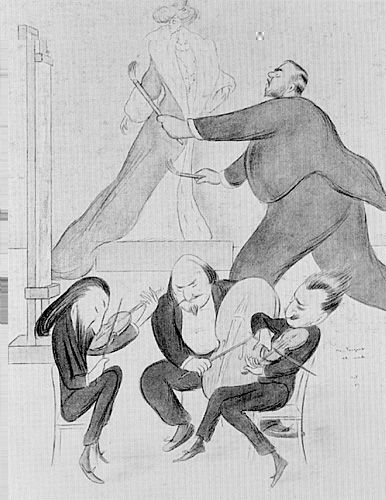
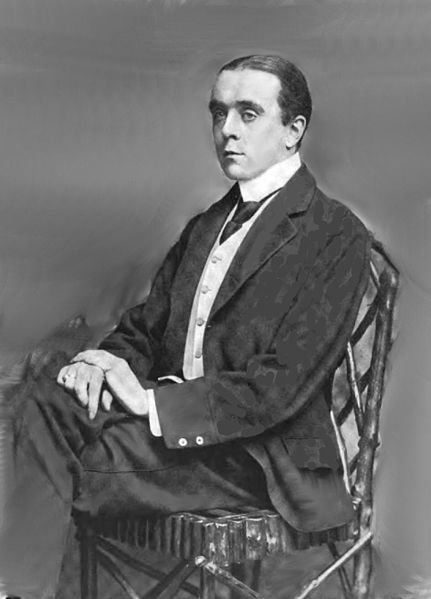
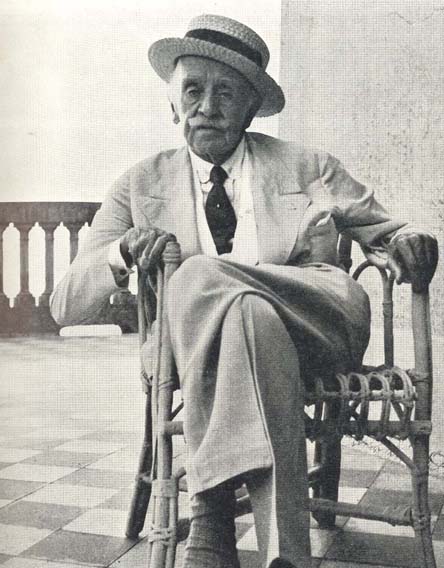
In addition to being a brilliant wit, humorist, and dandy, Max Beerbohm was one of the preeminent caricaturists of his day. His style was original and somehow inherently funny down to its lines and shapes. Below are a few of his caricatures from around the web:

Oscar Wilde:


Aubrey Beardsley:

One of Beerbohm's favorite targets was the Pre-Raphaelite group. Here is Swinburne reading to the Rosetti Brothers:


And a group caricature of the Rosetti Circle:


John Singer Sargent painting:


Here is a self-caricature of Max:


And a few photos of him, young and old: